Stuart Barden in Kenya
Friday, December 4, 2015
Friday, November 27, 2015
Tuesday, November 17, 2015
Short Rains Are Here
The short rains are over the period of November and half December, from June to October (five months) we received 23mm in 4 events, so zero effective rainfall.
Since the start of November we have had 80mm, we will need three times this amount to get even a 75% full soil moisture profile. At the end of Oct our fields were bone dry and the soil cracked open ready to receive the rain.
We will aim to plant our next crop in Feb if we can plant on moisture to make the most of April/May rains when the crops needs it most, these rains are known as the long rains. (truth is they are about the same length as the short rains, i.e. 6 weeks)
Since the start of November we have had 80mm, we will need three times this amount to get even a 75% full soil moisture profile. At the end of Oct our fields were bone dry and the soil cracked open ready to receive the rain.
We will aim to plant our next crop in Feb if we can plant on moisture to make the most of April/May rains when the crops needs it most, these rains are known as the long rains. (truth is they are about the same length as the short rains, i.e. 6 weeks)
Monday, November 16, 2015
Back home in Kenya after 15 day study tour of South America
Well after spending time in Brazil, Paraguay and Argentina the small group of us returned to our homes and farming businesses.
We saw lots of different approaches to cover crops, No Till and machinery that allows planting into high residue loads.
In Brazil and Paraguay there was obvious sub surface compaction although the 1600 to 20000 mm of annual rainfall masks it to a degree.
Lots of very good farmers and consultants growing good crops of Soya Beans and Corn.
We then moved into Argentina in an area called "The Pampas" silty clay soils that surprisingly don't appear to have the same degree of sub surface compaction as the red high % sand soils of Brazil/Paraguay.
One amazing thing was that we did not find one farm running on a CTF system. (Controlled traffic farming ).
Thanks to all the farmers/consultants/machinery manufacturers who gave us their time, it was greatly appreciated.
We saw lots of different approaches to cover crops, No Till and machinery that allows planting into high residue loads.
In Brazil and Paraguay there was obvious sub surface compaction although the 1600 to 20000 mm of annual rainfall masks it to a degree.
Lots of very good farmers and consultants growing good crops of Soya Beans and Corn.
We then moved into Argentina in an area called "The Pampas" silty clay soils that surprisingly don't appear to have the same degree of sub surface compaction as the red high % sand soils of Brazil/Paraguay.
One amazing thing was that we did not find one farm running on a CTF system. (Controlled traffic farming ).
Thanks to all the farmers/consultants/machinery manufacturers who gave us their time, it was greatly appreciated.
Sunday, November 15, 2015
Wednesday, November 11, 2015
Sunday, November 8, 2015
Saturday, November 7, 2015
Friday, November 6, 2015
Tuesday, November 3, 2015
11 t Hectare Cover Crop (dry matter)
We had our first day with two leading farmers in Brazil, both were planting Soya Beans into some serious residues.
Great day, lots to learn from the people we are meeting.
Our host "Cleber" from a company called "Stara" has been 1st rate.
Today was Day one of our study tour in South America., over the next 10 day's we will look at various farming systems in Brazil, Paraguay and Argentina. Busy 10 day's.
Great day, lots to learn from the people we are meeting.
Our host "Cleber" from a company called "Stara" has been 1st rate.
Today was Day one of our study tour in South America., over the next 10 day's we will look at various farming systems in Brazil, Paraguay and Argentina. Busy 10 day's.
Sunday, November 1, 2015
Starting Our South America Study Tour
We arrived in Sao Paulo (Brazil) this afternoon, heading to the home of Zero Till tomorrow.
Saturday, October 31, 2015
Friday, October 30, 2015
Monday, October 26, 2015
Saturday, October 24, 2015
Crazy Harvest and Grain cleaning finished
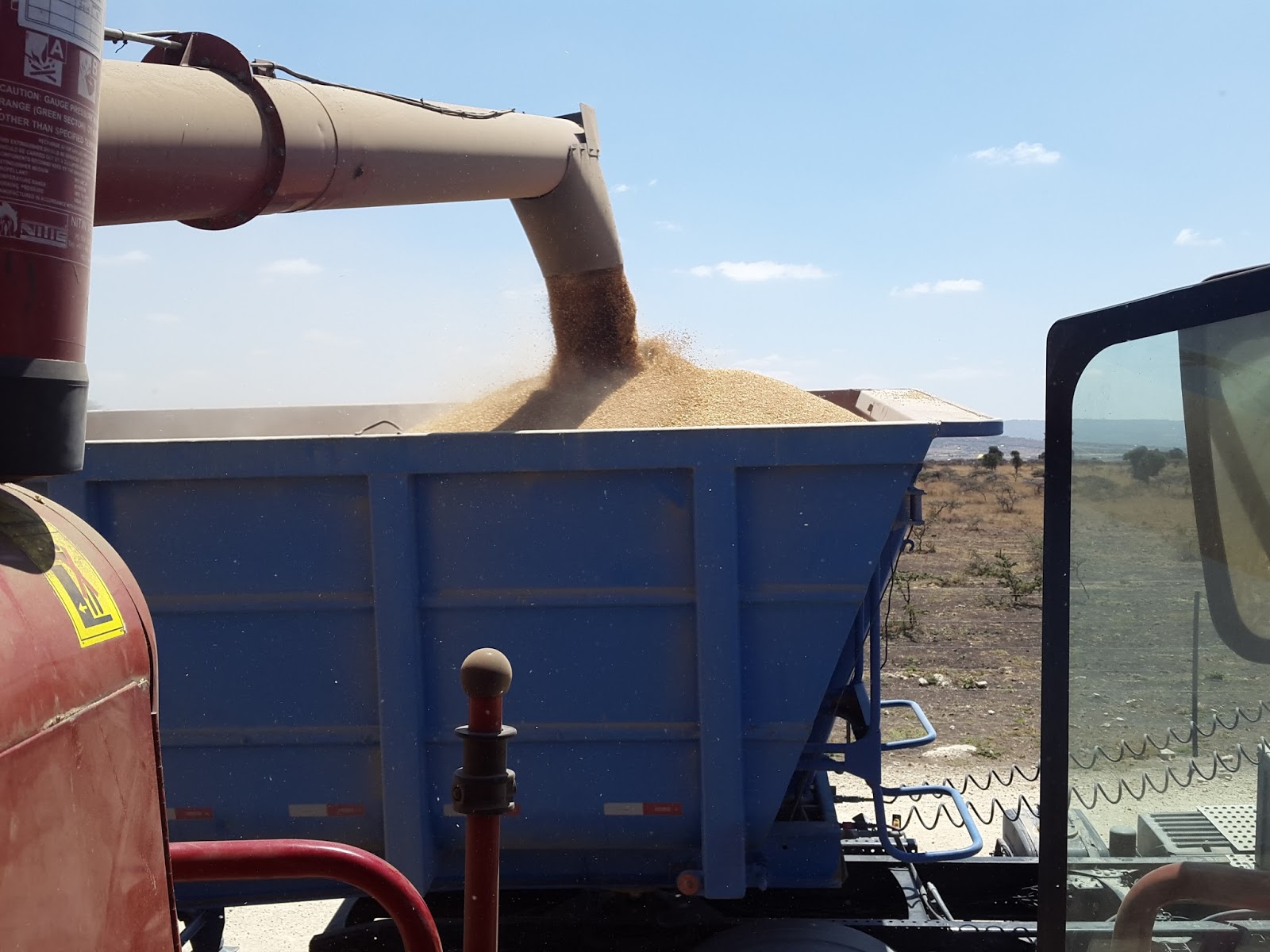
Finally after about 10 or 12 weeks of harvest and grain cleaning we are sending the last truck load off farm today (sat). It has been an intense time with harvest followed by our grain cleaner running 24/7 for a month and a half. The barley had to be cleaned 3 times to get us to 99% retention (above the screen).
Next season will be wheat and Mung Beans (green Grams) and a small commercial trial of both Desi and Kabuli chickpeas as well as a forage sorghum trial for potential pelletizing into the animal feed market.
Our whole team, Robert, Gideon and Samson are very happy to have a quite time for a while.
The short rains are almost here, they normally start at the end of Oct or start of Nov, it may rain 50mm over Nov/Dec or 300mm, time will tell.
Our soils are empty of moisture at present, our hope is that we can fill our moisture profile (the 1.25meters of black soil) up with the short Rains (Nov/Dec) then plant in Feb/March and have the long rains (April/May) falling in crop.
The average rainfall for April/May is around 155mm, so without moisture in our soil we would struggle to grow a viable crop.
On average we should be able to collect around 150mm of plant available water in our soils before we plant, i.e sub soil moisture.
This gives us a total of around 300mm with in crop and soil moisture, using a common water use efficiency method we would use the 300mm less 110mm which is 190mm then for wheat if we do it all right we should be able to achieve around 12 to 15kg of grain per mm. This should grow between about 2.3 t ha and 2.8 t ha.
Lots of talk of El Nino here in Kenya it means more rain than normal although as with all things climate, you just don't know what will happen.
Next season will be wheat and Mung Beans (green Grams) and a small commercial trial of both Desi and Kabuli chickpeas as well as a forage sorghum trial for potential pelletizing into the animal feed market.
Our whole team, Robert, Gideon and Samson are very happy to have a quite time for a while.
The short rains are almost here, they normally start at the end of Oct or start of Nov, it may rain 50mm over Nov/Dec or 300mm, time will tell.
Our soils are empty of moisture at present, our hope is that we can fill our moisture profile (the 1.25meters of black soil) up with the short Rains (Nov/Dec) then plant in Feb/March and have the long rains (April/May) falling in crop.
The average rainfall for April/May is around 155mm, so without moisture in our soil we would struggle to grow a viable crop.
On average we should be able to collect around 150mm of plant available water in our soils before we plant, i.e sub soil moisture.
This gives us a total of around 300mm with in crop and soil moisture, using a common water use efficiency method we would use the 300mm less 110mm which is 190mm then for wheat if we do it all right we should be able to achieve around 12 to 15kg of grain per mm. This should grow between about 2.3 t ha and 2.8 t ha.
Lots of talk of El Nino here in Kenya it means more rain than normal although as with all things climate, you just don't know what will happen.
Wednesday, October 21, 2015
Saturday, October 17, 2015
Saturday, October 3, 2015
Friday, September 11, 2015
Nature Opening the Door for the Rains
There is a lot of talk of El Nino recently, which in many parts of Australia's eastern side is related to below average rainfall, the converse is true in Kenya and the region, it is more often than not above average rainfall when an El Nino event is occurring, with greater volatility as well.
In Spanish the term "El Nino" refers to "the Christ child" or "the male child" whilst "La Nina" means "female or girl child"
Heavy black cracking soils (called "Black cotton" soils in east Africa) like we farm in Kenya crack open due to the clay particles contracting as they dry, this then effectively opens the "Door" to filling up the soil with moisture, it also allows for some recycling of shallow nutrients and organic matter to fall and reduce a "Stratification" of nutrients on the surface.
Nature is the ultimate zero till system!!
In Spanish the term "El Nino" refers to "the Christ child" or "the male child" whilst "La Nina" means "female or girl child"
Heavy black cracking soils (called "Black cotton" soils in east Africa) like we farm in Kenya crack open due to the clay particles contracting as they dry, this then effectively opens the "Door" to filling up the soil with moisture, it also allows for some recycling of shallow nutrients and organic matter to fall and reduce a "Stratification" of nutrients on the surface.
Nature is the ultimate zero till system!!
Sunday, September 6, 2015
Tuesday, September 1, 2015
Sunday, August 30, 2015
Wednesday, August 26, 2015
Some small plot trial results
Soya Bean planted 4/4/15, plant pop 24 plants per square meter,variety was DPSB19 yield 1.12 t ha
Mung Beans (green grams) planted 4/4/15 plant pop 27 plantrs per square meter variety was KS20 yield 2.51 t ha
Soya Bean planted 4/4/15, plant pop 26 plants per square meter, variety was DPSB8 yield was 1.27 t ha
Yellow beans planted 4/4/15 plant pop was 15 plants per square meter, variety "From Village next door" yield was 2.54 t ha (nice)
Soya Beans planted 4/4/15 plant pop was 17 plants per square meter, variety EHI3600, yield 1.62 t ha
Kabuli Chickpeas, planted 8/04/15 variety "from Tuskys supermarket" plant pop was 14 per square meter YIELD WAS 3.64THA
Soya Bean planted on the 8/04/15, variety was Nyala, plant pop was 25 plants per square meter, Yield 1.76 t ha (highest Soya yield)
All in all we got some interesting ballpark information (they are not replicated trials) from this seasons trials, Kabuli chickpeas , Local yellow Beans and Mung Beans (Green grams) look like crops we will take into commercial production.
Tuesday, August 11, 2015
New Buhler Grain Cleaner
Our home built for $3500 rotary grain screen just could not get us into specification (99% above the screen,.i.e retention) so we either wasted lots of $ on freight and grading losses to send the grain 200 plus km or we bought a grain cleaner, fortunately for us one of if not the biggest companies in the world of grain cleaning, flour mill machinery plus plus (google them they do just about every food processing gear including chocolate), Buhler just happened to have one of their TAS 152A-2 cleaners in the country, sitting 50km away in Nairobi, it is made in Germany and the quality is beautiful.
We have set it up temporally for now but when we finish building our grain store/shed we will move it to be able to clean direct from the 25t delivery pit and into the store/shed, it will clean wheat at 50 to 60t per hour so it will allow us to clean all our grain straight of the harvester.
As we deliver direct to end users we need to provide a clean product ready to mill or malt.
We have set it up temporally for now but when we finish building our grain store/shed we will move it to be able to clean direct from the 25t delivery pit and into the store/shed, it will clean wheat at 50 to 60t per hour so it will allow us to clean all our grain straight of the harvester.
As we deliver direct to end users we need to provide a clean product ready to mill or malt.
Subscribe to:
Posts (Atom)